"My Patients Weren't Losing Their Hair, They Were Losing Their Afternoons," says Doctor of 22 Years
A Virginia physician spent two years asking why thinning men couldn't stop checking mirrors, and found the topicals they kept buying never reached the follicle at all.
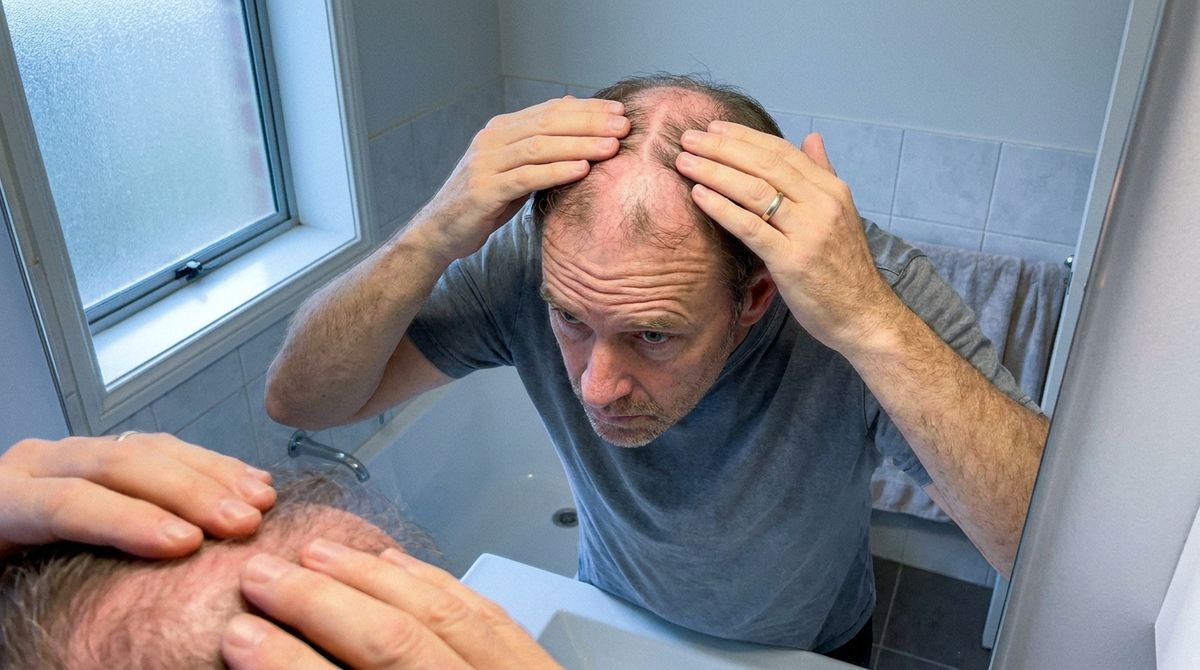
You comb it the same way every morning. You angle the mirror to check the crown.
You sit in the back row of the group photo. And somewhere in there, a part of your brain never fully clocks out.
You've tried the foam. You've tried the shampoo that smells like a pharmacy.
Maybe you eyed the pills and read enough Reddit threads to put them back down. Nothing moved.
So you manage it. You hide it.
You think about it more than you'd ever admit out loud.
That last part, the thinking about it, is what Dr. Tobias Brandt says nobody measures.
"For twenty-two years I treated the scalp," Brandt told this publication. "It took me embarrassingly long to notice I was treating the wrong organ. The hair was the symptom. The thing wrecking these men was the noise it put in their heads, the hat they grabbed on the way out, the photo they ducked, the wedding they half-enjoyed. I had no way to fix that, because I couldn't fix the cause."
The Sentence Every Specialist Repeats
Ask most clinics about male hair loss and you'll hear the same two-part answer that's been recited since the late '90s: there's a foam that forces blood to the scalp, and there's a pill that lowers a hormone called DHT body-wide. Both are real treatments.
Both have their place. Neither has meaningfully changed in the advice columns in over twenty years. "The guidelines are a glacier," Brandt said.
"They move, but you'll be retired before they finish. So a man walks in, gets the same script his father got, and when it doesn't work he assumes he's the problem. He isn't."
DHT, for the record, is not some exotic villain.
It's a normal hormone, the one behind your beard and your deeper voice.1 In men whose follicles are sensitive to it, it latches onto the root, chokes off the blood supply, and starves the follicle a little more each growth cycle until it shrinks and stops producing visible hair.
That part the field has understood for decades. Which raises the obvious question Brandt couldn't shake.
Why The Stuff You Rub On Never Arrives
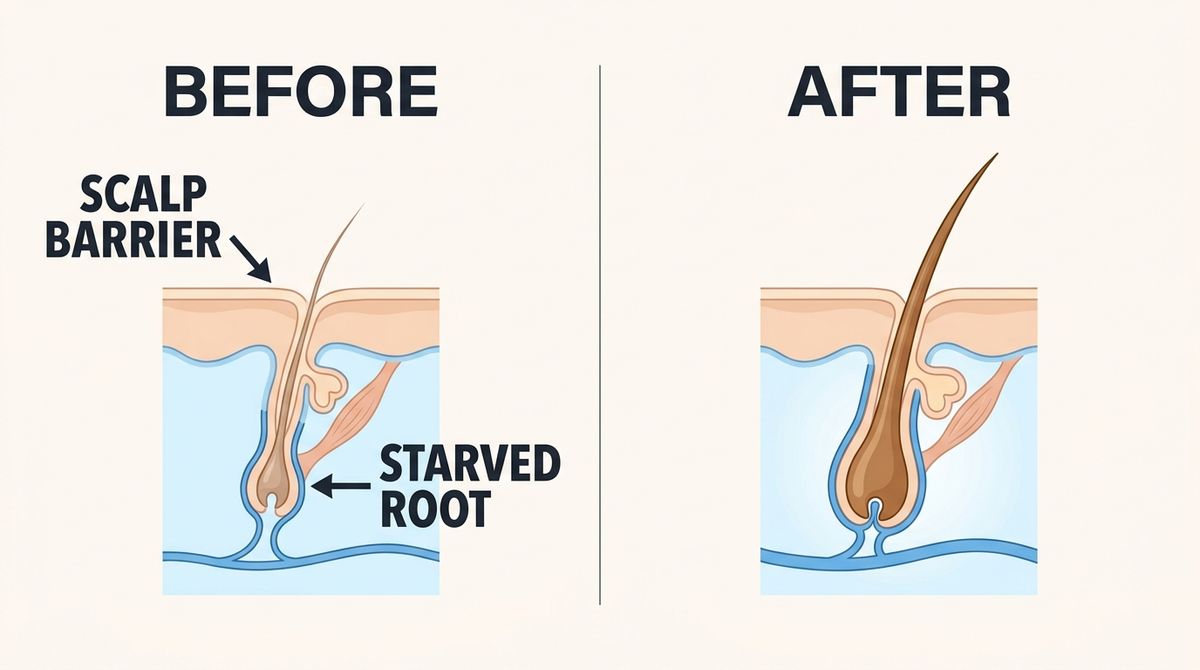
If the follicle root is the problem, why doesn't anything you put on your scalp fix it? The answer is almost stupidly physical.
The follicle root sits below the surface of the skin, and the outer layer of your scalp exists for one job: to keep things out. It is, functionally, a sealed barrier.
So the foam, the serum, the oil, the caffeine shampoo, they land on top of that barrier and stop there.
The vast majority of any topical evaporates, washes off, or simply never crosses the skin to reach the root.2 "It's not that the ingredients are weak," Brandt said. "Some of them are excellent. It's that they're standing outside a locked door knocking. The active never gets into the room where the hair is made." That's the part no shampoo bottle prints on its label. You weren't failing the treatment.
The treatment was failing to show up.
The $240-A-Month Treadmill
The other answer men get pushed toward is the prescription pill. It works for some. But it works the way a fire alarm works, by suppressing DHT across your entire body, not just your scalp.
For a chunk of men, that systemic reach comes with a list they didn't sign up for: dropped libido, brain fog, mood changes. The kind of side effects that make a man quit and lose any hair he gained. The foam has a different trap.
It never touches DHT at all, it just forces circulation. The day you stop, the borrowed hair leaves with it. And the running cost adds up.
Between branded foam, the pill, and the consults, a committed routine can run somewhere around $240 a month, indefinitely, because the moment you stop, you're back where you started. "Men are renting hair," Brandt said, dryly. "Miss a payment and the landlord takes it back. Nobody calls it that, but that's the arrangement."
What The Standard Routine Actually Costs You
- The foam: Forces blood to the surface. Never addresses DHT. Stop using it and the gains shed out.
- The pill: Lowers DHT through your whole body, not just the scalp, which is where the side-effect stories come from.
- Monthly outlay: Around $240 for a committed routine, paid indefinitely.
- The quiet cost: The daily mental tax, the hat, the angle, the dodged photo, that no prescription touches.
What An Old Hospital Idea Was Doing Wrong
Brandt's turn came from a place he didn't expect: burn medicine.
There's a copper peptide called GHK-Cu used in clinics to help rebuild tissue after severe burns, one of the most-studied repair molecules there is.4 In hair research, it had been shown to send regeneration signals to damaged follicles, rebuild the blood vessels around them, and cut shedding dramatically in clinical observations.
"I'd known about copper peptides for years," Brandt said. "What I'd resigned myself to was that you couldn't get them where they needed to go. Same locked door. Brilliant ingredient, no delivery." The fix had been sitting in plain sight.
Microneedling, creating hundreds of tiny channels in the scalp, had clinically been shown to grow hair on its own, partly by triggering the body's own wound-healing response.5 But on its own it only does half the job.
It opens the doors and pushes nothing through them. The overlooked move was to do both at once: open the channel and infuse the peptide through it in the same motion, while the channel is still open.
Through that route, far more of the active reaches the follicle than from a topical sitting on intact skin.2
Two Peptides, One Already Open Door
Brandt's investigation kept pointing back to a small formulation team that had already bottled exactly this approach, a microinfusion device paired with a peptide serum, marketed under the name BlueForce Follifusion. What earned it a serious look wasn't marketing.
It was that the serum hinged on two peptides doing two different jobs, delivered through the same channels. GHK-Cu does the repair, rebuilding the starved follicle and waking dormant tissue.
Adenosine, a molecule used in Japanese hair clinics for decades, does the growth, it works inside the follicle's growth cells to extend the growing phase and thicken the strand.
In head-to-head trials it has matched, and in some cases bettered, the standard topical for visible regrowth.6 Around those two, caffeine and rosemary block DHT right at the follicle, locally, without touching the hormone anywhere else in the body.
You take the pressure off the root without the body-wide reach that makes the pill rough on so many men. The device is 24-karat gold-plated, which matters less for luxury than for hygiene, gold is naturally antimicrobial, so the channels stay clean while they're open.
- Open and infuse, the gold microneedles create hundreds of clean channels through the skin barrier and push the peptide serum straight to the follicle root in the same motion. Most men report shedding easing within the first one to two weeks.
- Take the pressure off, caffeine and rosemary block DHT at the follicle through two different natural pathways, locally, while GHK-Cu repairs the starved root. First baby hairs typically show along the hairline around weeks two to four.
- Hold the gains, adenosine extends the growth phase and an 8-form collagen complex strengthens the anchor around each follicle, so density builds through weeks five to twelve and the new hair holds instead of cycling out fast.
Sixty-One Men, And The Thing They Reported First

Brandt's office tracked 61 men through the approach for twelve weeks. The hair tracked the way the research predicted, less shedding early, baby hairs by the first month, visible density building by week eight for most of the group.
But the change that stuck with him was the one he'd gone looking for in the first place.
The large majority reported they'd stopped consciously managing their hair, the reflexive mirror-check, the hat by the door, the seat in the back, within those twelve weeks.3 "The relief showed up before the hair fully did," Brandt said.
"The moment a man believes something is finally reaching the problem, he stops carrying it around all day. I didn't expect the head to quiet before the scalp filled in. It did."
He is careful about the framing. Results vary. Some men in the group saw less than others, and a few weeks for most showed nothing at all.
An Idea Nobody Profits From Standardizing
If the delivery problem is this well understood, why isn't this the standard advice? Brandt's answer isn't a conspiracy. It's inertia.
"The guidelines that train every clinic are slow by design," he said. "They wait on decades of consensus before they rewrite a recommendation. That's reasonable for safety. It's terrible for a man who's losing hair right now while the committee schedules its next review." There's no committee racing to fast-track an at-home device a man buys once and uses himself.
There's no sales rep with a reason to retrain a field that's recited the same two-option answer since the Clinton administration.
So the foam-and-pill script keeps getting handed out, not because it's the best the science has, but because it's the answer the system already knows how to give. "The information isn't hidden," Brandt said.
"It's just nobody whose job it is to update the script has any reason to hurry."
How To Actually Try It
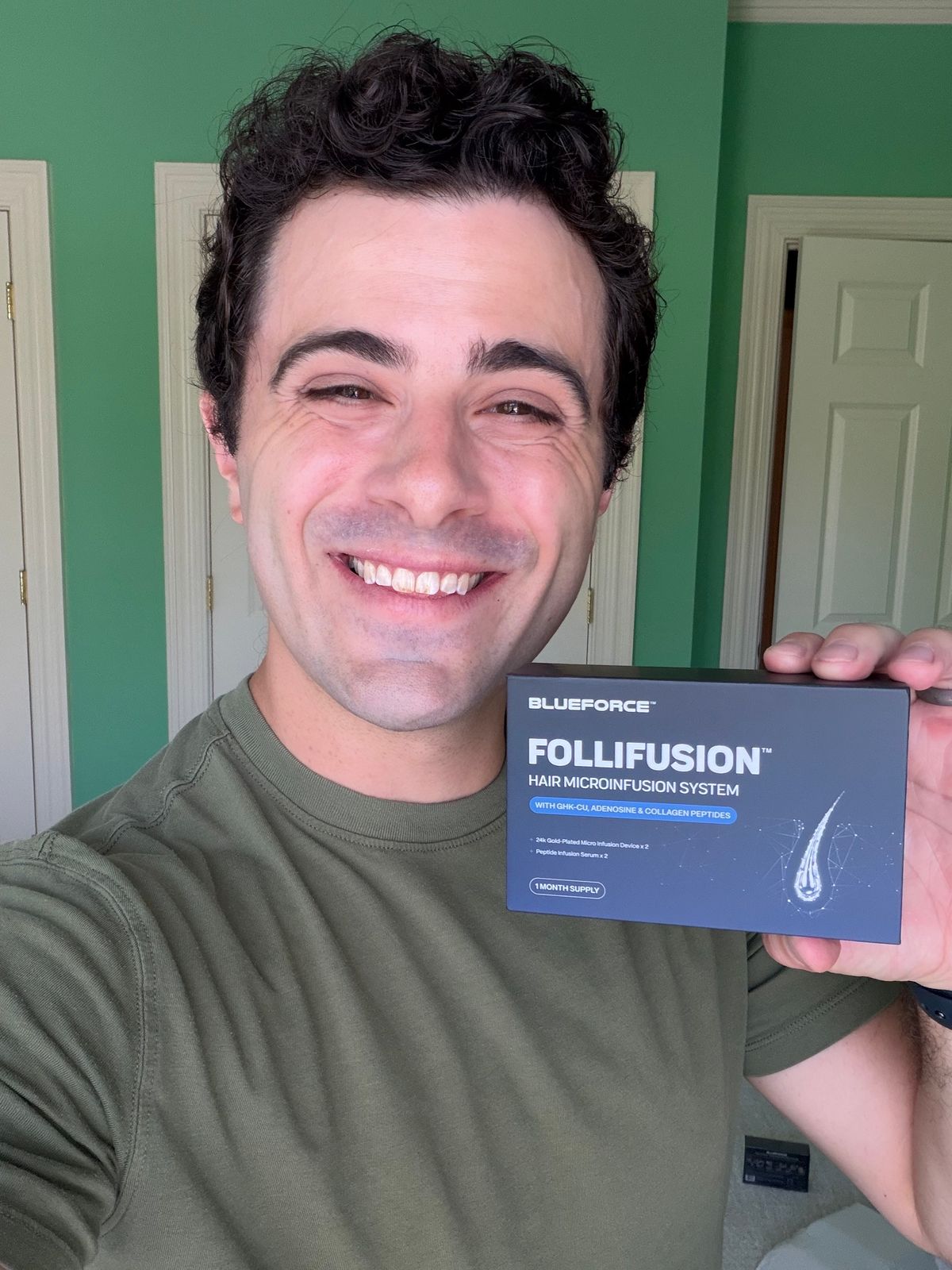
BlueForce Follifusion isn't sold through clinics or on Amazon, the company ships it directly, partly so men know they're getting the real device and serum and not a watered-down knockoff.
When you anchor it against the routine it replaces, the math is hard to argue with. A committed foam-plus-pill regimen runs somewhere around $240 a month, forever. This is a per-bottle purchase you can stop without losing what you grew.
Normally it's $79 a bottle. On this page today, it's $39 a bottle. It's backed by a 90-day money-back guarantee, including on opened, used devices, because the company is betting most men won't want to send it back.

The Afternoon You Get Back
Brandt is blunt about what the standard advice gets wrong. It treats the scalp and ignores the head. "A receding hairline doesn't ruin a man's life," he said.
"The constant low-grade accounting does, the part of him that's always half-checking, always half-hiding. You give him something that finally reaches the root, and the noise stops first. The hair follows."
It isn't your fault that the foam didn't work. It was never built to cross the door it was knocking on. The men in Brandt's group didn't try harder.
They just stopped using a delivery method that never delivered. Whether you start now or wait for the guidelines to catch up in another decade is, as Brandt put it with a shrug, "A choice you get to make. The committee certainly isn't in a hurry to make it for you."


REFERENCES
- Internal practice observation notes, T. Brandt clinical office, Richmond VA (12-week tracked cohort, n=61). Not a controlled trial; reported outcomes only.
- Singh A, Yadav S. "Microneedling: Advances and widening horizons." Indian Dermatology Online Journal. 2016;7(4):244-254.
- Pickart L, Margolina A. "Regenerative and Protective Actions of the GHK-Cu Peptide." International Journal of Molecular Sciences. 2018;19(7):1987.
- Watanabe Y, et al. "Evaluation of the efficacy of adenosine in male androgenetic alopecia." Journal of Dermatology. 2015;42(8):759-766.
- Dhurat R, et al. "A Randomized Evaluator Blinded Study of Effect of Microneedling in Androgenetic Alopecia." International Journal of Trichology. 2013;5(1):6-11.
- Fischer TW, et al. "Effect of caffeine and testosterone on the proliferation of human hair follicles in vitro." International Journal of Dermatology. 2007;46(1):27-35.