The Top 5 Micro-Infusion Systems For Hair Growth — And The One That Passed All Our Tests.
Most devices poke holes in your scalp but push nothing through them. We compared active formulas, delivery, and real results so you can stop guessing.
Micro-infusion for hair growth has exploded in popularity — especially among men dealing with thinning, receding hairlines, and hair loss that nothing else has fixed.
Between the failure of topical treatments, the side effect fears around prescription hormone pills, and the $10K+ price tag of transplants, men are turning to micro-infusion faster than any other method on the market.
Micro-Infusion For Hair Growth Can help with:
But here's what most men trying micro-infusion don't realize: without the right clinical actives delivered at the right moment, their device could be doing almost nothing.
And most devices just poke holes and deliver nothing through them. Without a growth serum flowing through the channel the instant it opens, the follicle never gets the signal to wake up.
And even when a system does include a serum, there's a second problem most brands ignore: if the device and the serum are separate steps, the channels are already closing by the time the ingredients touch the surface.
That's why the best systems deliver the serum through the needle in one motion — a copper repair complex to heal the follicle, a growth activation compound to drive new hair, and DHT blockers to protect what you just woke up. All reaching the follicle root while the path is wide open.
The problem? Almost no brands do all three. Some skip the serum entirely. Others use plant extracts with no clinical actives. And most separate the needling from the delivery — which means the window closes before anything gets through.
We tested the top five micro-infusion systems and ranked them on their active formula, delivery timing, DHT protection, needle quality, and real results.
A few results surprised us — especially which popular brand landed near the bottom.
The Top 5 Micro-Infusion Systems For Hair Growth
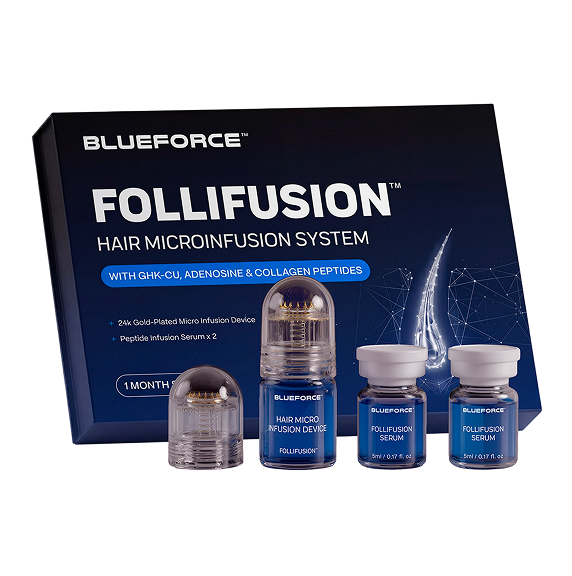
BlueForce didn't just beat every micro-infusion system here — it exposed the flaw in all of them.
Most brands sell you a stamp with no serum. Or a serum with no device. BlueForce built the only system where the growth serum travels through the needle at the exact moment the channel opens.
The copper repair complex starts fixing the follicle before the channel even closes.
Our testers saw less shedding in week one, new hairs by week four, and real density by week eight.
Bottom Line: BlueForce Follifusion™ is the only system delivering a 34-ingredient dual-active serum through 24K gold needles in one motion.
BlueForce Is Offering 50% OFF for Our Readers (Limited Supply)
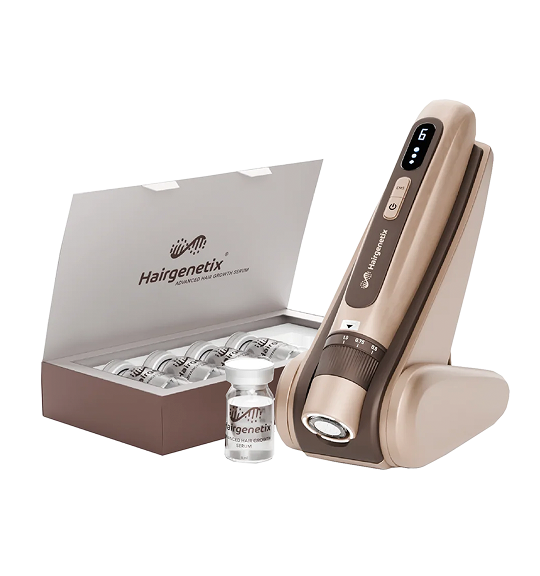
Hairgenetix has a really high raw active dose and they also have a study showing less shedding with copper compounds. But the system has serious holes.
No growth activator — so you're fixing the follicle but never telling it to keep growing. No DHT blockers — so the same hormone that killed the follicle keeps attacking it the day after treatment. No collagen to hold anything in place.
And the pen is reusable. On a scalp full of open channels, that's a bigger risk than most guys realize. Dull needles from reuse create uneven channels. Leftover bacteria from a bad wipe-down go straight into open skin. Single-use sterile devices exist for a reason.
Our testers saw some shedding reduction by week three — slower than BlueForce. But new growth was thin and sparse. By week eight, two testers had lost the early gains entirely.
Without a growth activator driving the growth phase and without DHT protection, the follicles woke up, produced a few weak hairs, and went back to sleep.
Verdict: Strong science on the repair side. But no growth activator, no DHT protection, and a reusable pen that needs cleaning after every use. It repairs follicles but doesn't finish the job.
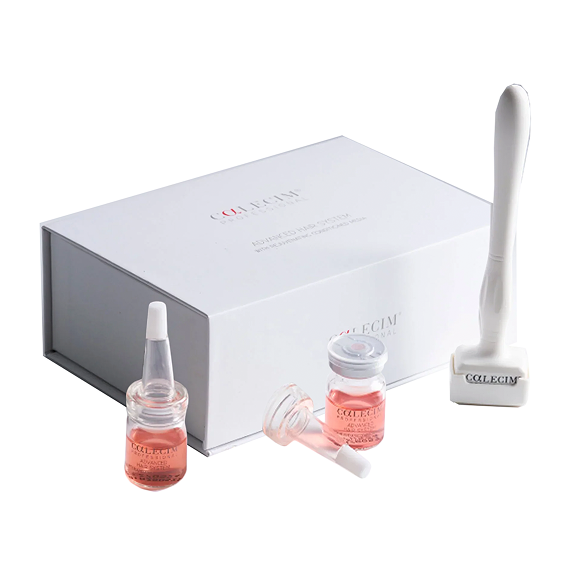
Calecim brings good science to the table. For a growth-factor-only approach, the pedigree is quite nice. But that's all it does. There's no copper repair complex. No growth activator. No DHT blockers. No collagen support. Calecim relies entirely on your body's healing response to do the heavy lifting — without giving the follicle any direct repair, any growth-phase extension, or any protection from the hormone that shut it down in the first place. At $360 for a six-week supply, you're paying clinic-grade prices for a system that covers one layer of the problem.
Our testers saw mild improvement in shedding by week four. But new growth was slow to appear and thin when it did. Without a compound that directly extends the growth phase, follicles woke up but cycled back out too fast.
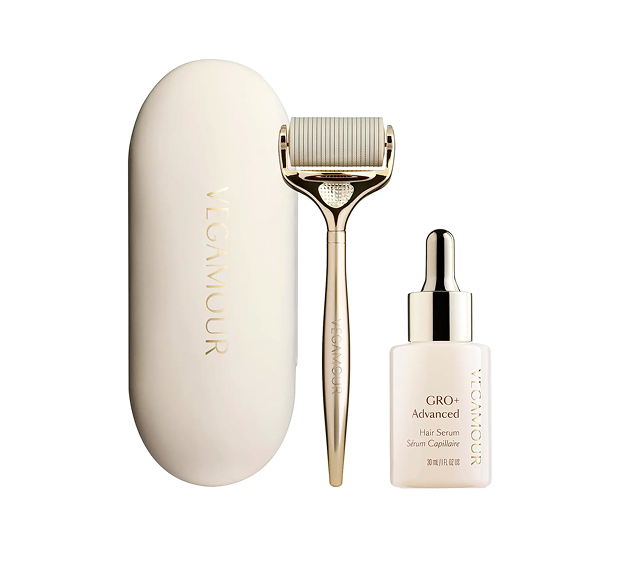
Vegamour has established a clean hair care brand. The GRO+ serum contains red clover, mung bean, curcumin, and caffeine — ingredients with small studies supporting scalp health. But this isn't a micro-infusion system. And that's why it falls apart.
The dermaroller is sold separately and used as a different step. You roll first. Then you apply the serum after. That means the channels are already closing by the time the ingredients hit the surface.
The ingredients themselves are also plant extracts — no copper repair complex, no growth activator, no direct follicle repair or growth activation. The roller uses a rolling motion that enters the skin at an angle. Stamps go straight down. Rolling can drag, snag hair, and create uneven channels. Experts consistently flag this as a scarring risk.
Testers saw mild shedding reduction after about six weeks. But new growth was minimal even at 12 weeks. The serum is gentle. The delivery is surface-level. For early-stage thinning, it might slow things down. For real regrowth, it doesn't have the tools.
Verdict: Vegamour is a good brand with a clean reputation. But plant extracts applied after a separate roller can't reach dormant follicles. No clinical actives, no simultaneous delivery, no DHT protection — this is a scalp health product, not a regrowth system.
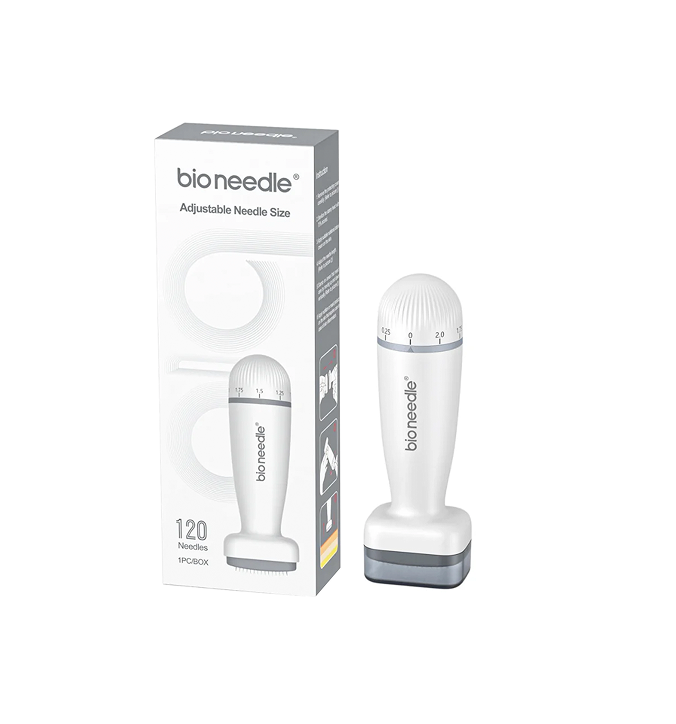
Dr. Pen is a budget-friendly and widely available option for microneedling beginners.
However, the major drawback is that it offers no serum delivery system, meaning you are just opening channels without applying beneficial ingredients like growth compounds or DHT blockers.
Furthermore, it uses basic, non-germ-resistant stainless steel needles and is reusable, requiring self-sterilization that is often done improperly, posing a significant infection risk to an open scalp.
Our testers saw the least improvement of any system tested. Mild scalp stimulation. Some increased blood flow. But no shedding reduction, no new growth, and no density change at 12 weeks. Microneedling alone triggers a wound-healing response. But without active compounds delivered through those channels, the follicles stay dormant.
Verdict: Dr. Pen Bio Needle is microneedling without the infusion. You're opening doors in your scalp and walking away. For $25, you get the stamping motion right. But without a growth serum delivered at the same time, the follicles never get the signal to wake up. This is half a system sold as a whole solution.
Why Most Micro-Infusion Doesn't Work
Most men who've tried microneedling for hair growth followed the same path. Buy a roller or stamp online. Use it once a week. Apply whatever serum they already had. Wait. Wait longer. See nothing. Quit.
That's not because microneedling doesn't work. It does. The wound-healing response is real. Blood flow surges. Growth factors release. But those channels close within 60 to 90 minutes. If the right actives aren't delivered through them while they're open — you miss the window entirely.
And most devices don't deliver anything. They create the channels and stop. The serum goes on after — sitting on the surface, drying up, never reaching the follicle root.
That's why "just microneedling" plateaus fast. You get mild scalp stimulation. Maybe some extra blood flow. But the follicle never gets the repair signal (copper complex), the growth signal (growth activator), or the protection (DHT blockers) it actually needs.
If you've been stamping your scalp for weeks with nothing to show for it — the device wasn't broken. The system was incomplete.
Is Micro-Infusion For Hair Growth Really Worth It?
For men stuck in the cycle — trying shampoos, supplements, rollers, and serums that never deliver — yes. But only with a system that actually gets the right ingredients to the follicle root.
Microneedling alone boosts hair regrowth significantly compared to topicals. But when you add peptide delivery through those channels at the same moment they open, the effect gets much stronger.
Copper-binding tripeptide has been shown to reduce shedding by up to 93%. Adenosine outperformed minoxidil for visible regrowth in a trial of 102 men — without the rebound shedding when you stop.
Most testers noticed shedding slow down within the first two weeks. By week four, new hairs started showing up along the hairline and edges of thinning zones. By week eight, density was visibly filling in. The biggest gains came from testers who had already failed with minoxidil and derma rollers — the ones who thought nothing would work.
Give it at least eight to twelve weeks. Use it every two weeks. And make sure what you're using has the peptides, the delivery method, and the DHT protection to actually reach the follicle and keep it growing.
Special Offer for Our Readers
After BlueForce earned the top spot in our micro-infusion review, we reached out to their team. They agreed to extend an exclusive offer for our readers.
BlueForce Follifusion™ is the only system in this comparison that delivers a 34-ingredient dual-peptide serum through 24K gold microneedles in a single motion — with copper-binding tripeptide, adenosine, caffeine, rosemary, and an 8-form collagen complex reaching the follicle root while the channels are open.
Our Top Pick — BlueForce Follifusion Micro-Infusion System